

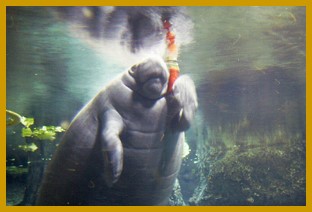
Surveys and research of manatee populations since the 1970s. HSWRI’s Melbourne Beach facility currently hosts the east coast manatee rescue team for Florida Fish and Wildlife Conservation Commission.
Selected Publications:
Alves-Stanley, C.D. and G.A.J. Worthy. Carbon and nitrogen turnover rates and diet-tissue discrimination in Florida manatees (Trichechus manatus latirostris). The Journal of Experimental Biology. 212:2349-2355. 2009.
Alves-Stanley, C.D. and G.A.J. Worthy. Feeding preferences of the West Indian manatee in Florida, Belize and Puerto Rico, as indicated by stable isotope analysis. Marine Ecology Progress Series. 402:255-267. 2010.
Courbis, S.S. and G.A.J. Worthy. Opportunistic rather than incidental carnivory by Florida manatees (Trichechus manatus latirostris)?. Aquatic Mammals. 29:104-107. 2003.
Fire S.E., L.J. Flewelling, M. Stolen, W.N. Durden, M. de Wit, A.C. Spellman and Z. Wang. Brevetoxin-associated mass mortality event of bottlenose dolphins and manatees along the east coast of Florida. Marine Ecology Progress Series. 526:241-251. 2015.
Jaffe, J., F. Simonet, P.L. Roberts, and A.E. Bowles. Measurement of the acoustic reflectivity of Sirenia (Florida Manatees) at 171 kHz. Journal of the Acoustical Society of America. 121(1): 158-165. 2007.
Leatherwood, S. Aerial Survey of Bottlenosed Dolphins, Tursiops truncatus, and the West Indian Manatees, Trichechus manatus, in Indian and Banana Rivers, Florida. Fish. Bull. 77(1): 47-59. 1979.
Odell, D.K. Sirenia Life History. Encyclopedia of Marine Mammals. Academic Press, San Diego, CA. 2002.
Ortiz, R.M. and G.A.J. Worthy. Could lower body fat mass contribute to cold-water susceptibility in calves of the West Indian manatee (Trichechus manatus)?. Marine Mammal Science. 20:176-183. 2004.